Battery Amp-Hour Calculator
Estimate the house-battery capacity you need for dry camping. Add the loads you actually use, then compare the usable capacity of lead-acid and LiFePO4. For loads not listed, add their amp draw to the closest category or use a battery monitor for a measured estimate.
Calculate amp-hour needs
Enter your typical use for one dry-camping night. Estimates are a planning starting point—not a substitute for your appliance labels, battery monitor, or installer.
Assumptions: 12.0 V nominal system, 90% inverter efficiency, 50% usable lead-acid capacity, 80% usable LiFePO4 capacity, and 20% planning reserve. Actual results vary with temperature, battery age, wiring, and surge loads.
How to use the result
Treat the result as a starting point. Check the battery’s temperature rating, continuous and peak current limits, charging profile, compartment ventilation, and the wire/fuse requirements. Solar can reduce generator or shore-power time, but it does not eliminate the need to size for cloudy days and overnight use.
How to install (wiring overview)
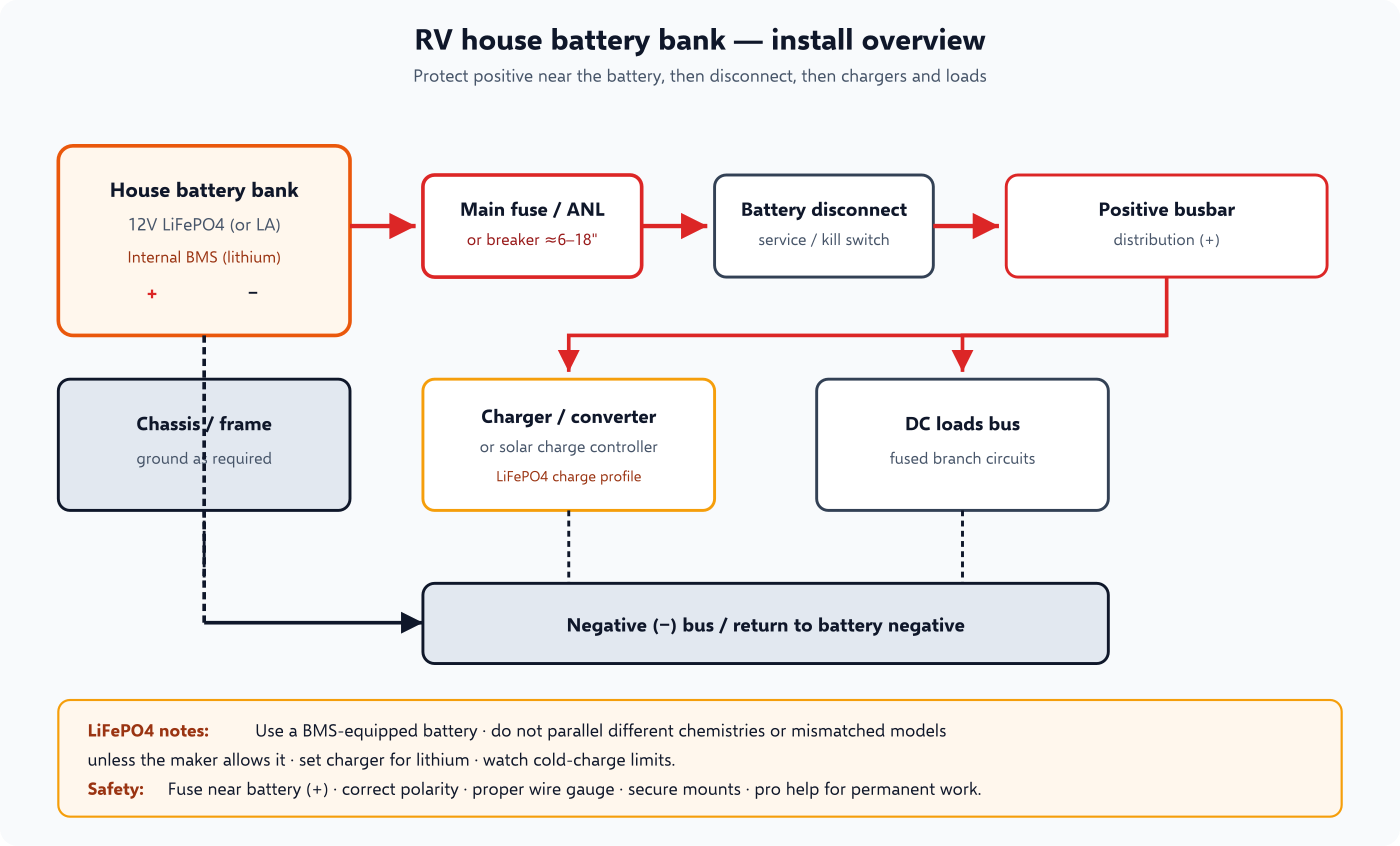
After you estimate amp-hours, plan the physical bank: protected positive near the battery, a service disconnect, charging equipment, and fused DC loads. Use this overview while you size cables and fuses—then confirm everything against your battery and charger manuals.
⚠ Safety first — read before any electrical work
Working on RV electrical systems can cause shock, fire, or equipment damage. If you are unsure at any step, stop and hire a qualified RV technician or electrician.
- ALWAYS disconnect shore power first — unplug the shore cord and turn off / remove it from the pedestal before opening panels, converters, inverters, or battery compartments.
- Also disconnect or isolate the battery bank (use the battery disconnect) before working on DC wiring. Wait for capacitors to discharge if applicable, then verify with a multimeter that circuits are dead.
- Never work on wet surfaces. Use insulated tools. Respect polarity. Place a correctly rated fuse near the battery positive.
- Confirm BMS continuous current before adding a large inverter load.